Mahomet
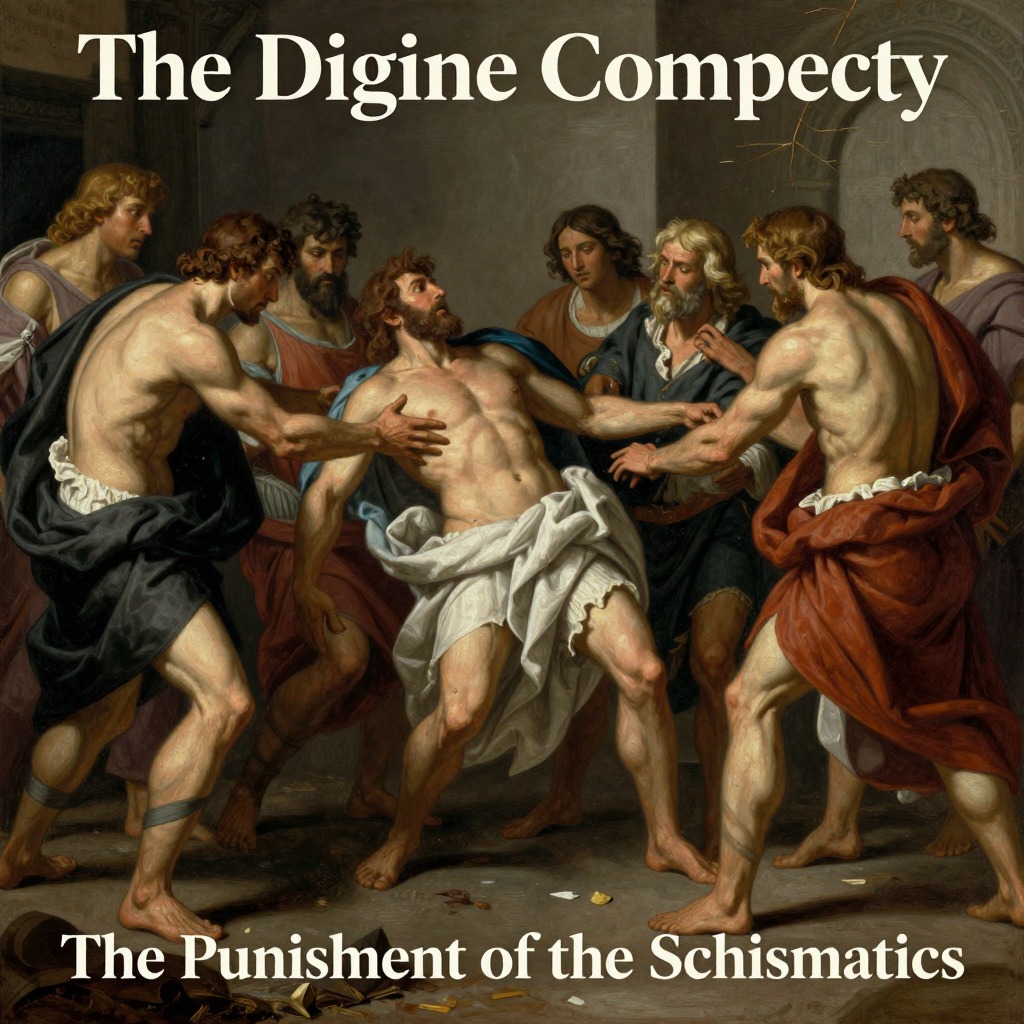
Mahomet is one of the most visually shocking figures in Dante's Inferno, appearing in the Ninth Bolgia of the Eighth Circle, where schismatics are punished. His body is split open from the chin to the point where one breaks wind, with his entrails hanging between his legs and his heart and the 'dismal sack' that makes excrement visible. This grotesque mutilation is a precise instance of contrapasso: as Mahomet caused division within the faith, so his own body is perpetually divided. He is not merely a historical figure but a symbol of the ultimate schism within Christianity, placed among the worst of the fraudulent sinners.
Appearance and Self-Identification
When Dante first sees him, Mahomet is standing, and he opens his bosom with his hands to display his wound, saying, 'See now how I rend me; / How mutilated, see, is Mahomet.' He immediately identifies himself and points out that Ali, his son-in-law, walks before him weeping, cleft in the face from forelock to chin. This pairing emphasizes that the punishment extends to all who followed him in creating division. Mahomet's speech is direct and without shame; he seems almost to boast of his condition, as if the very act of self-display is part of his eternal torment.
The Mechanism of Punishment
Mahomet explains the perpetual cycle of his suffering. A devil stands behind the sinners, cleaving them with a sword as they walk around the dolorous road. The wounds close again before each sinner repasses the devil, so the process repeats endlessly. This mechanical, unceasing violence mirrors the way schismatics, in life, repeatedly reopened wounds within the Church. The fact that the wounds heal only to be reopened suggests that the division they caused is never truly mended, only temporarily obscured.
Prophecy and Warning
Before departing, Mahomet delivers a warning to Dante. He says, 'Now say to Fra Dolcino, then, to arm him, / Thou, who perhaps wilt shortly see the sun, / If soon he wish not here to follow me, / So with provisions, that no stress of snow / May give the victory to the Novarese, / Which otherwise to gain would not be easy.' This prophecy refers to the historical Fra Dolcino, a leader of a heretical sect who was besieged and executed in 1307. Mahomet's warning is both a prediction of Dolcino's fate and a demonstration that the damned retain knowledge of future earthly events, a theme Dante explores elsewhere in the Inferno.
Narrative Role and Significance
Mahomet's presence in the Inferno serves multiple purposes. He is a historical and religious figure whose punishment Dante uses to condemn all forms of religious schism, particularly those that threatened the unity of Christendom. His placement in the Ninth Bolgia, among the worst of the fraudulent, underscores the gravity of dividing the faithful. The vivid, visceral description of his mutilation is one of the most memorable in the poem, and his prophecy adds a layer of contemporary political and religious commentary. Mahomet is not a character with a personal story or redemption; he is a symbol of the ultimate consequence of schism, his body a permanent testament to the violence of division.